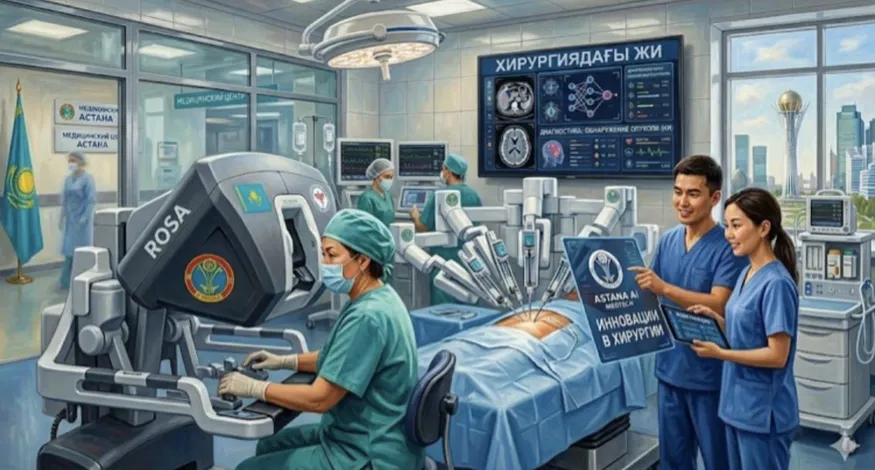
Astana – In the high-stakes world of surgery, where a millimeter can be the difference between recovery and complication, the steady hands of veteran surgeons are increasingly being augmented by silicon and steel. From the capital’s elite clinics to regional centers, Kazakhstan is quietly positioning itself as a regional hub for robotic-assisted medical innovation.
For decades, the complexity of an operation rested solely on a surgeon's dexterity and years of experience. Today, that paradigm is shifting. Artificial intelligence is now actively assisting doctors in diagnosing ailments, planning intricate procedures, and predicting risks before the first incision is made.
The Dawn of the Robot Assistant
While the global medical community continues to debate the balance between efficiency and safety, Kazakhstani practitioners are embracing these "intelligent assistants". Experts are quick to clarify: these systems are not autonomous replacements for humans but sophisticated tools designed to eliminate the "human factor" – the tremors or fatigue that can lead to errors.
The lineage of this technology stretches back to the Canadian Arthrobot, but today’s gold standard is the Da Vinci system. With over 9,000 units installed worldwide, Da Vinci has revolutionized surgery, slashing operation times from seven hours to as few as two. In the first half of 2026 alone, procedures using Da Vinci assistants rose by 17 percent globally. In Kazakhstan, this technological wave is manifest in systems like ROSA, MAKO and MISSO.
A New Standard of Precision
In Almaty’s City Clinical Hospital No. 4, the MAKO robotic system is transforming orthopedics. By creating 3D models from CT scans, it allows surgeons to install implants with a level of accuracy previously unattainable.
"With the robot’s help, the surgeon doesn't make mistakes," says Dan Zhadygerov, a high-ranking orthopedic traumatologist who trained in Moscow and Turkey. He notes that the technology allows for partial joint replacements rather than total ones, leading to significantly faster recovery times for patients, typically aged 50 to 70.
Further north in Astana, the National Scientific Center for Traumatology and Orthopedics has deployed MISSO, an AI-powered "smart surgical assistant".
Meanwhile, at the Green Clinic, the ROSA system – developed by the American firm Zimmer Biomet – has already assisted in over 30 operations this year.
"Patients get back on their feet faster because the implants and prosthetics are placed so precisely," explains surgeon Ersin Usin. "The balance of ligaments and muscles is perfectly maintained."
From Local Success to Global Reach
Kazakhstan's journey into robotic surgery began in earnest in 2018 in Oskemen, where a robot assisted in a gallbladder removal. By 2025, the country achieved a stunning milestone: a cross-border tele-surgery where a surgeon in Beijing removed a kidney tumor from a patient in Almaty, thousands of miles away.
The Medical Center of the President's Affairs Administration has been a particular focal point for this progress, recently performing Central Asia's first robotic heart surgery to repair a congenital defect. To date, their Senhance robotic system has completed over 860 operations, primarily for cyst and gallbladder removals.
The Human Element and the Cost of Progress
Despite the mechanical precision, the legal and ethical weight still rests firmly on human shoulders. Under Kazakhstani law, the doctor remains the primary figure responsible for diagnosis and treatment tactics.
The transition to a robotic future is not without its hurdles. The primary barrier is accessibility. These systems are currently concentrated in Astana and Almaty, and the costs remain high. At the Green Clinic, a single joint procedure starts at 3.8 million tenge ($8,000 approx.). While this is significantly cheaper than similar services abroad, it remains a steep price for many.
There is also the matter of training. Working with these systems requires years of preparation. "We prepared for two years – studying abroad, practicing on biomaterials and cadavers," says Dr. Usin. "We only began practicing here after receiving specialized certification."
The AI Frontier
Beyond the operating theater, AI is becoming a diagnostic powerhouse. Domestic startups like Cerebra – recognized by Medtronic as one of the world's most innovative medical AI projects – are automating the diagnosis of strokes. Newcomers like ImmuniGuide assess immune systems, while NeuroGuard, founded by young scientist Karina Sekenova, uses AI to detect brain vascular pathologies like aneurysms and stenoses.
As these technologies mature, the goal remains clear: to reduce medical errors and make high-quality care more accessible. While doctors like Ersin Usin believe it may take another 5 to 10 years before robots take on an even more dominant role, the transformation of Kazakhstani medicine is already well underway.