By 2050, the number of people with Parkinson’s disease worldwide may reach 25.2 million — almost three times the current figure. The highest numbers are expected in East and South Asia — 10.9 million and 6.8 million, respectively, according to the British Medical Journal. The main reason is an aging population.
The difficulty of diagnosis is emphasized by 12th-grade NIS student and Mind Shield co-founder Fariza Ramazanova:
"Parkinson’s disease is hard to diagnose because its early symptoms are often subtle and can be mistaken for age-related changes. At the third and fourth stages, only surgery, including brain surgery, can help. The cost of such operations is 12–15 million tenge. Often they are covered by OSMS."
Together with like-minded students from NIS, Fariza created an app for early detection of Parkinson’s disease, investing around 70,000 tenge in the project.
Project Beginning
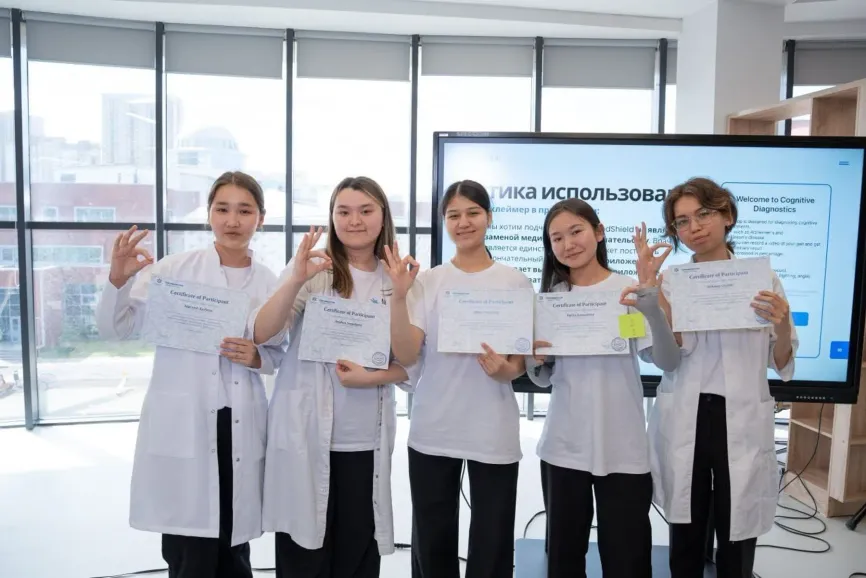
The idea came from student Dilnaz Nurkhamit in September 2024: her grandfather was diagnosed with late-stage Parkinson’s disease, and early detection could have facilitated treatment. That same month, Dilnaz and the team applied to the international Technovation Girls competition and began developing the Mind Shield app.
The team of five — Fariza Ramazanova, Erkenaz Orazaly, Sagynish Kazieva, Aruzhan Sergalieva, and Dilnaz Nurkhamit — worked on the project for eight months.
"By May 2025, the app was ready. Around 70,000 tenge were spent, mostly on purchasing medical data. Erkenaz and I handled programming, while the other team members took care of organizational tasks," Fariza says.
Diagnostic Features
The app detects Parkinson’s through hand movements, mainly finger tremors. Users need to record a 10–15 second video, quickly tapping their thumb and index finger together. The system then provides the probability of having the disease — from 20% (low) to 70% (high).
"The system processes the recorded video, extracts movement coordinates using the video library, and transfers them to a neural network. The nature of the tremor is analyzed to determine the probability of Parkinson’s disease. The algorithm is based on a Bidirectional LSTM model — a type of neural network that can account for movement dynamics over time. We also use model bagging: several neural networks are trained with different parameters, and a final score is issued. This is the predictive indicator showing the likelihood of Parkinson’s symptoms. The accuracy of our model is 93%," explains Fariza.
The neural network was trained with the help of an NIS mentor — computer science teacher Kadir Maratuly. The video library contains over 250 videos of hand movements from both healthy people and Parkinson’s patients.
Testing and High Accuracy
To test the app, the team attended a forum for Parkinson’s patients.
"There we tested the app and simultaneously expanded our video library. For those diagnosed with Parkinson’s by doctors, we confirmed the same diagnosis through our app. This showed that our model is quite accurate. Overall, we tested over 50 people at various events," Fariza notes.
Mind Shield is scheduled to launch for mass use in November–December 2025. The subscription will cost around 1,500 tenge per month, making the app accessible for retirees.
Anti-Tremor Bracelet: How It Works
In 2025, the project founders decided to go further by developing an anti-tremor bracelet. It operates on a battery.
"This bracelet helps relieve symptoms of Parkinson’s disease: tremor, dyskinesia (motor dysfunction — Ed.), and so on. The bracelet’s vibrations reduce the severity of tremors and other motor impairments. Tremor occurs at a certain frequency, and the bracelet adapts to this frequency using a gyroscope, then vibrates in response. As a result, hand tremors are reduced. The bracelet is best worn continuously or during tremor episodes," Fariza explains.
The creation of the anti-tremor bracelet cost 10,000 tenge, covering electronics for the first prototype and 3D printing.
"The bracelet has a plastic case, which we 3D-printed at the American Corner and Makerspace Astana," the team notes.
The idea for the bracelet was proposed by parkinsonologist Gani Bazarbekuly.
"After monitoring, we found that similar anti-tremor devices exist in the U.S. market. Some are even more convenient than our bracelet — they look like compact watches. In the future, we plan to improve our model. We tested it on patients with Parkinson’s, and according to feedback, it gradually shows effectiveness," the team emphasizes.
The estimated price will not exceed 10,000 tenge. The development team is already applying for a government grant and looking for mentors to further develop the project.
Read the full exclusive interview on Kapital.kz.