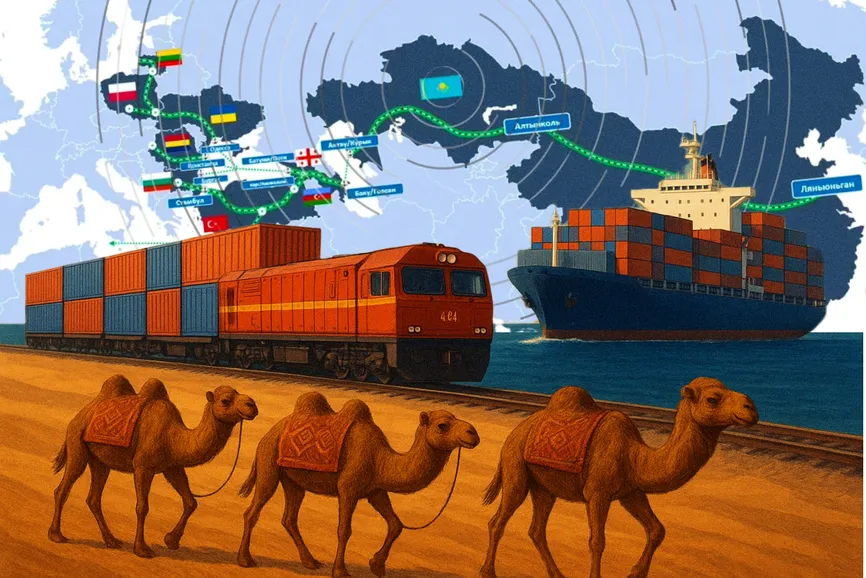
During his recent visit to the United States, Kassym-Jomart Tokayev announced Kazakhstan’s support for the U.S. president’s peacekeeping initiatives, including the “Trump Route for International Peace and Prosperity” (TRIPP), which may contribute to the further development of the Middle Corridor (also known as the Trans-Caspian International Transport Route, or TITR).
A total of eight international corridors pass through the territory of Kazakhstan, making the country a central hub of the Belt and Road Initiative and a key transit partner for China, the European Union, and Central Asia. The most dynamic of them is the Middle Corridor, with transit through it increasing by 62% in 2024, reaching 4.5 million tons of cargo. The TITR passes through China, Kazakhstan, the Caspian Sea, Azerbaijan, Georgia, and European countries. The length of the Middle Corridor exceeds 11,000 km.
On the territory of Georgia, the route branches into three parts heading westward.
Experts believe that the Middle Corridor has strategic importance specifically for the countries of the region, as they have almost no alternatives. The functioning of this corridor is also closely tied to the pricing on the ocean route. When ocean freight prices are high, flows through the TITR and the Northern Corridor increase; when ocean prices fall, demand for these services decreases.
Industry experts note that the Middle Corridor has become in demand due to geopolitical developments and emphasize that rail transport remains the fastest way to deliver goods along the China–Europe route. Kazakhstan has infrastructure whose potential has not yet been fully realized, experts are convinced. The TITR is considered a promising investment direction with strategic importance for Kazakhstan and the entire region. A number of large infrastructure projects are being implemented along the Middle Corridor, including those involving foreign capital and international financial institutions.
It is worth noting that in January 2024, at a forum in Brussels (Belgium), it was announced that the European Union would invest 10 billion euros to improve the transit infrastructure of the Middle Corridor. This is the volume of investment that the EU allocated to the five Central Asian countries in the first stage. According to preliminary estimates by the International Association “Trans-Caspian International Transport Route,” at least one-third of this amount will go to warehouse real estate — 3.5 billion euros by 2027.
In October of this year, it was reported that Kazakhstan would invest more than $23 billion in the development of transport corridors by 2035. It is planned to invest $16.7 billion, or 71.7%, in the development of the road sector, and $4.2 billion (18%) in the railway sector. Another $1.5 billion (6.4%) will be directed to the development of seaports and the Caspian fleet, including the international trade port of Kuryk — a key multimodal hub of the TITR. Projects for the development of logistics centers, border crossing points, and airport cargo terminals are estimated at $0.9 billion (3.9%).
In October 2025, it was also announced that JSC “Sovereign Wealth Fund Samruk-Kazyna” and the Azerbaijani transport and communications holding AZCON signed a memorandum of cooperation for the joint development of the Middle Corridor. The agreement provides for the possibility of operating new RoPax-class ferries on the Caspian Sea, which will be built at the Baku Shipyard. RoPax-class ferries are modern vessels capable of carrying both passengers and vehicles, the Fund said.
Overall, by the end of 2024, the total volume of transit transportation through Kazakhstan amounted to 34.6 million tons, which is 7.1% more than in 2023 (32.3 million tons). This figure is planned to increase to 67 million tons by 2029 and to 100 million tons by 2035, the Ministry of Transport reported in September 2025.
For reference: on November 7, 2013, the heads of JSC “National Company Kazakhstan Temir Zholy” (KTZ), CJSC “Azerbaijan Railways,” and JSC “Georgian Railway” signed in Astana an Agreement on the establishment of a Coordination Committee for the development of the TITR within the framework of the second International Transport and Logistics Business Forum “New Silk Road.”
To increase cargo traffic along the Middle Corridor, in February 2014 a Coordination Committee for the development of the TITR was established, initially comprising JSC “Georgian Railway,” JSC “NC Aktau International Sea Commercial Port,” KTZ, CJSC “Azerbaijan Railways,” CJSC “Azerbaijan Caspian Shipping Company,” CJSC “Baku International Sea Trade Port,” and LLC “Batumi Sea Port.”
In December 2016, the participants of the Coordination Committee for the development of the TITR – Kazakhstan, Azerbaijan, and Georgia — decided to establish the International Association “Trans-Caspian International Transport Route,” which began its activities in February 2017.