


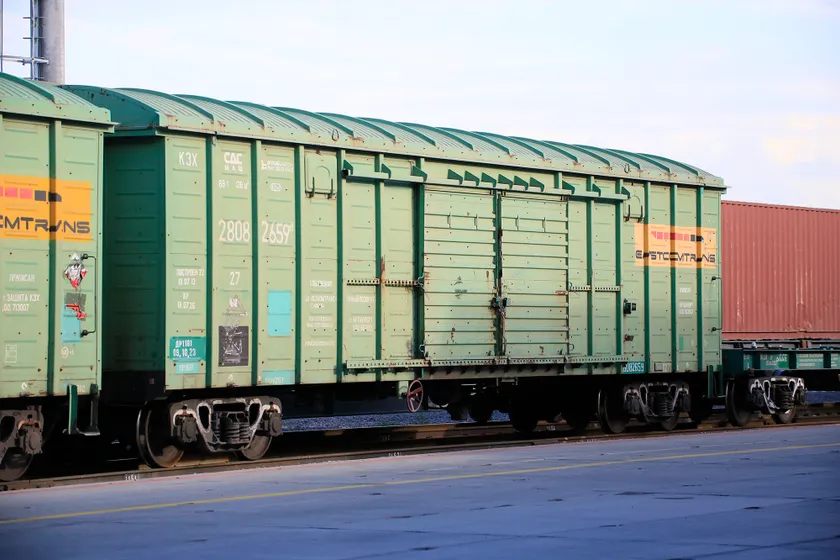
Kazakhstan Temir Zholy (KTZ) and Russian Railways (RZD) are expanding their partnership in rail freight transport.
Between January and October 2025, rail freight volumes between Kazakhstan and Russia reached 71.6 million tons, up 5% year-on-year.
Kazakhstan’s exports grew by 5% to 43.8 million tons. The largest increase came from coal shipments through Russian ports, which totaled 9.6 million tons — a 34% rise from 2024. The main routes include the Baltic ports (6.2 million tons, +18%) and the Azov–Black Sea basin (3.4 million tons, +83%).
Grain exports through Russia surged fivefold, reaching 1.9 million tons, with 500,000 tons shipped through Russian seaports. The main exports include grain, lentils, and oilseed crops, with Italy, Belgium, Turkey, and Algeria among the key destinations.
Container traffic between Kazakhstan and Russia rose by 13% to 650,000 TEUs.
Meanwhile, freight flows along the China–Russia–China route grew 15-fold over the past six years — from 33,400 to 512,000 TEUs — and climbed another 9% in 2025.
KTZ and RZD continue to develop transport corridors, enhance border capacity, and introduce digital services to strengthen transit potential and maintain stable cargo flows between the two countries.
Source: Kazakhstan Railways