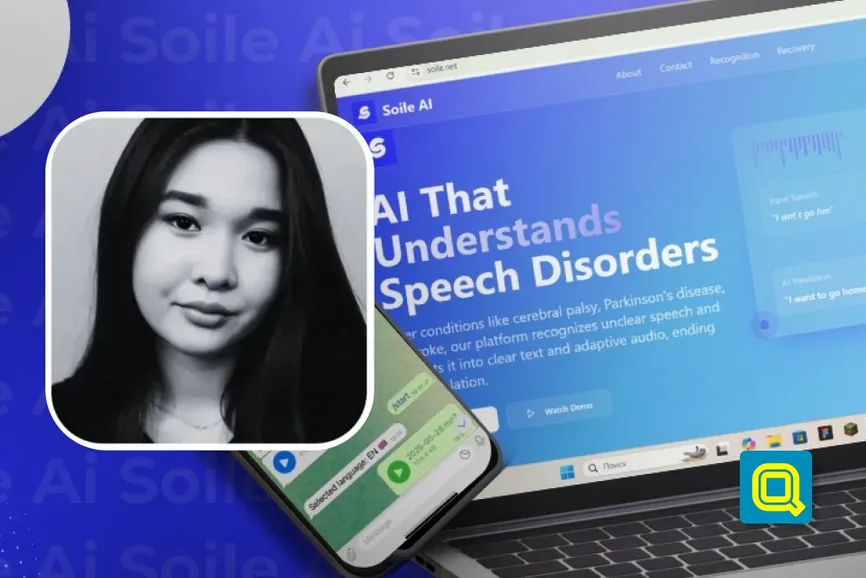
A schoolgirl from the village of Karabulak in the Almaty Region, Ukili Omarova, has proposed a solution to a global problem. Her startup, Soile AI, helps people who have lost their ability to speak communicate. The startup has already received an international patent, QazMonitor correspondent Ainur Shoshayeva reports.
An Idea Born From a Family Story
While many startups begin with market research, Ukili Omarova’s project started with a personal story. Her grandparents suffered strokes, after which communication between close family members seemed to be cut off.
“When I was little, my grandfather had a stroke, and then my grandmother. After that, we stopped understanding them. My grandfather could not speak at all, and when he tried, his speech was unintelligible. My grandmother also could not speak for some time after her stroke, but later her speech recovered,” she said.
This experience left the schoolgirl with a persistent question: “Why isn’t there a device that could understand them?” After becoming familiar with the IT field a year ago, Ukili began searching for an answer through technology.
From a Hackathon to a First Victory
As soon as Ukili Omarova first heard the terms “programming” and “startup,” she realized how vast the possibilities of this field were. At one of her first hackathons, she decided to bring her childhood idea to life using AI.
“To better understand IT and improve my skills, I attended various hackathons. Last year, at one of them, we had to come up with a solution for the inclusive community, for people with disabilities. At first, the idea was completely different, but then I remembered my own story and decided to conduct quick research,” she added.
According to her, the results were shocking: more than 800 million people worldwide have speech impairments. This confirmed that she was on the right path, and the initiative ultimately earned her first place at IT-Fest 2024.
Data Collection: 24,800 Unique Recordings
Developing a medical startup requires significant persistence, especially when there is no ready-made voice database for training neural networks. Ukili had to personally approach patients and ask for permission to record their voices.
“During this time, we collected 24,800 unique recordings. They were in Russian and Kazakh. Other CIS languages will also be added to the platform. We are currently further improving Kyrgyz and Uzbek. Recently, I came up with a new solution so we don’t have to collect recordings manually. Users can record and upload their own voice samples within the app. In other words, they ‘feed’ the service with data. Thanks to this, the AI adapts individually to each person and learns on its own,” she said.
To build the datasets, Ukili established cooperation with 19 clinics and speech therapists. Since the project began, the team has trained the model on 88.5 hours of collected material in the Kazakh language.
How Does Soile AI Work?
Today, using Soile AI requires only a regular smartphone. The system, which operates through a Telegram bot, converts the sounds produced by a person with a speech impairment into text and then reads it aloud in a clear voice. The project is currently preparing for release on the Play Market and the App Store.
“The app includes more than 300 types of conditions. The current model recognizes cerebral palsy, post-stroke conditions, stuttering, and others quite well. I want the use of this model to be free during the first few years while we are building the database. But at all startup competitions I say that it will be paid, because it is a startup. Still, the price will be very affordable — just 5,000 tenge per month. In the future, however, the app will become completely free, because I want this technology to benefit society,” she noted.
A $90 Billion Market
According to Ukili, her project has attracted interest not only from investors but also from international companies. One foreign medical company even offered to buy the project, but the young founder declined.
“This is because in the future this technology could be acquired by major international tech companies. At present, very few systems accurately recognize the voices of people with speech impairments, especially in Kazakh or Kyrgyz. This technology is aimed specifically at solving that problem. Analysts predict that by 2030 the Voice AI market could reach $90 billion. So this is a highly promising field, both economically and in terms of inclusion and social impact,” the startup founder said.
Ukili Omarova is a resident of Asfendiyarov Kazakh National Medical University. Her team consists of two more members, both schoolgirls: one handles marketing, the other provides technical support. As the founder and CEO, Ukili is responsible for strategic decisions. Notably, the girls launched the project with zero funding.
“I didn’t invest my own money in the project. I develop everything using prize money I win at various competitions. In startup terms, this is called bootstrapping. My main goal is to help people in need,” she concluded.
Ukili Omarova’s story is a vivid example of how studying at a rural school can lead to solving technological problems on a global scale. Soile AI has the potential to become a breakthrough not only in Kazakhstan but also in the global field of inclusion. She now plans to scale the project by expanding the dataset, integrating voice calls, and entering the mass market with user applications.