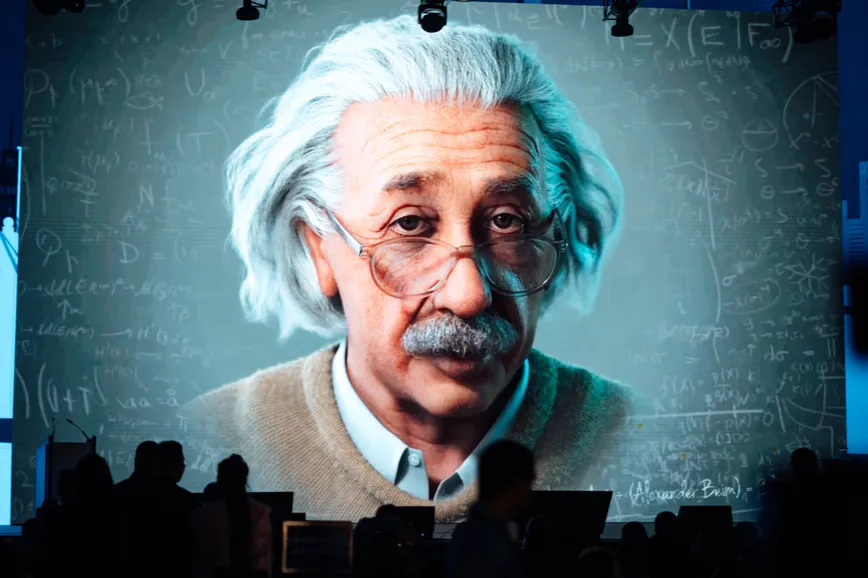
On October 5, global experts in science and technology discussed the pressing challenges of today's world, from emerging AI technology to the need to formulating a new worldview at the VI Nobel Fest educational forum in Astana, QazMonitor reports.
During the opening ceremony, Science Minister Sayasat Nurbek spoke about major shifts all across the globe, including OpenAI's ChatGPT, which is revolutionizing our understanding of everything humanity knows. He emphasized the importance of Kazakhstan keeping pace with these changes.
"Together with Google in Kazakhstan, we have initiated the launch of a pilot course on artificial intelligence at fourteen universities. If this course proves successful, starting from next year, there will be a literacy course in this field in all universities across the country," said Nurbek.
Nobel Peace Prize laureate for his efforts in combating climate change, Rae Kwon Chung, stated in his speech that the world has reached a juncture where conventional knowledge is no longer sufficient.
As Albert Einstein once said, 'We cannot solve future problems with past knowledge.' In other words, we cannot only depend on conventional knowledge. Whether it is liberal democracy, free market capitalism, or environmental management and social policies, [if it's] based on conventional knowledge it will not be enough to solve the social, political, economic problems we face right now. Then what do we need? We need more than intelligence, we need insight. Insight to use artificial intelligence—ChatGPT [for example]—as a tool, not as our master.
To achieve this insight, the speaker stressed the necessity of forming a new vision for the future, one that envisions an inclusive and sustainable world. In this context, as an expert on climate change, Chung highlighted that while global warming presents a significant challenge, it also opens up new opportunities—a ‘blue ocean’ of sorts—a new market open for everyone.
The next speaker, Pascal Mayer, recipient of the Breakthrough Prize for pioneering inexpensive and rapid DNA sequencing, also addressed the challenges posed by artificial intelligence.
“Today, there’s another phase of AI that is emerging. [And this phase] is when the AI starts to replace humans. For example, in generating news, images, and soon movies. It will become very difficult and it’s already difficult to distinguish between real news and fake news. In the future of AI, it may be a world where a big challenge will be to trust in information, to trust in what you see on the web, on the news, and on TV,” stressed Mayer.
As such, the speaker pointed out that a significant element of the future landscape will be trust, as a factor that could aid people in their day-to-day lives.
Echoing the sentiments of previous speakers, future studies scholar Gerd Leonhard drew the audience's attention to the fact that while technology can address practical problems related to food, water, energy, and more, collective human challenges require more than just technology. Part of this issue lies in the fact that industrial society operates on the principle of using technology to generate greater profits.
According to Leonhard, humanity is currently undergoing three revolutions that are shaping the world around us – the digital revolution, the sustainability revolution, and the purpose revolution.
What is the purpose of the economy and our future? And the purpose is not just profit, growth, and more jobs, as that was the purpose of my generation – the baby boomers. Did you know that 50% of CO2 that's generated around the world was generated in the last twenty-five years? That's my generation's doing. Now we have the millennials, the Gen-Y, say that, 'We want a different life, we don't just want profit, growth, and more money. We want [different] three things – sustainability, good purpose, and future.'
The scholar emphasized that the future could indeed be bright, but for that to happen, humanity needs to learn how to cooperate proactively, rather than waiting for another problem to arise. Citing examples such as nuclear disarmament and the development of COVID-19 vaccines, Leonhard pointed out that action only took place after the fact. In this context, global cooperation on AI should begin now and not tomorrow.